

One of my favourite songs is by the late, great country singer Toby Keith, titled Don't Let the Old Man In. There's a line in it I've always loved: "If you didn't know the day you were born, how old do you think you would be?"
My answer is a lot younger than what it says on my birth certificate! I don’t like the thought of my time running out while there is still so much to do, so much more to write about.
My business career was a rollercoaster of achievement and disappointment, with one constant—the thrill of the next deal. The disappointment never came about through the project; instead, it came through global events, like the share market crash and the GFC, for example. My working world was very sensitive to global banking conditions.
I worked on projects that, to me, mattered because they contributed to the development of my country's economic and tourism infrastructure. If it came down to a choice, this ideal came first. Outside of the property development game, I was able to invest in hospitality and sporting ventures.
The journey brought incredible people into my life as I transitioned from one industry to another. It made for a colourful patchwork of friendships and unforgettable moments. But it wasn't all good times. Some chapters were seriously challenging, sometimes lasting years, that required a daily grind mindset, for there was no other choice.
My early working life began on the land. Leaving home for good at eighteen to go farming also meant leaving behind my comfortable middle-class life. My first boss definitely saw me coming. He was relentless as he drilled to the bottom of my well, my apprenticeship as a farmhand, musterer, shearer, fencer—whatever needed doing. Over the following couple of years, I was broken in by some of the country’s toughest men. They didn't teach enjoyment; they taught endurance. They showed me how to keep going, how to live alone in remote places with little more than a bunk in a drafty hut, and the whistle of the wind as it slipped through gaps in the wall to lull me to sleep, much like the noise of a jet engine on a plane. There was no TV, no radio, no phone—just some tatty and torn books—and space to dream.
Sometimes, it really was a world of nothing.
But there was an upside: the horses. These incredible animals that helped build nations, win wars, and change the world. Horsepower—literally. As a young farmhand, I would rise at 4 a.m. and head out to gather the horses for feeding and grooming before the workday began. It wasn't idyllic — in fact, it was shit. But a few hours later, I would find myself on a high-country spur, just me, my horse, and my dogs, gazing out over God's own country. But it was a hard-earned reward.
However, there were blissful moments of achievement. Back then, I could roll a cigarette one-handed—a vital skill since the other hand was always on the reins. Just so you know, one-handed, you would need to get the cigarette paper out of your shirt pocket, stick it to your lip, then with the same hand, get the tobacco out of its bag, place it on the cigarette paper, roll it, lick it, put it on your lips, and then with the same hand get your Swan match with its wax tip, then with your thumbnail, flick the wax head, setting it alight, then putting it to the rolled smoke. I remember feeling euphoric when I finally mastered it. It was an essential skill, according to my boss. During a muster, we rarely stopped moving. We just kept driving the herd forward. That little trick became a badge of honour. Having mastered it, I turned it into a contest among the lads for a bit of pocket money—rolling, lighting, and smoking, all with one hand, a race against the clock.
Later, I discovered that you could flick a beer bottle top like a Frisbee with a snap of your fingers. The old ones had cork inserts, which made the trick possible. Today's caps don't function the same way. I practised until my thumb and finger were raw, then introduced the trick to the boys again. It was like having a portable ATM following me around at my disposal. As far as I know, I still hold the unofficial record: 18 metres. On the rare occasions we got to the pub, my winnings all went on the bar. [Not that I had any choice in the matter] My wage was $64.70 a fortnight, so we weren't flush.
Back to the horses. In the mornings, they'd mess with me. I'd stumble into the paddock, bridles in hand, still half-asleep. They'd see me and bolt. I'd instinctively chase them into a corner—total waste of time. One morning, I gave up. I turned my back and stood still. After a while, they wandered up behind me and nudged me, almost as if to say, "Sorry, boss—we were just fucking with you. We're ready now."
My time in the saddle was brief. The university came calling, followed by overseas travel. But during that short time, I formed a comfortable connection with all the horses I rode. These days, I could watch thoroughbred racing all day, not for the punting, but for the backstories of the horses, the jockeys, the trainers, and the stables; hell, even the fashion on display brought to life by the brilliant broadcasters the industry always seems to find. Imagine my delight when Gai Waterhouse gave me her permission to use her character in Gifted. Gai has recently bought up her one-hundred and fiftieth Group One win. She is an Australian treasure.
Right, back to the farm! On a Sunday, our only day off, we played rough "mock polo" matches—broomsticks for mallets, old cricket balls for the polo ball. Not for the faint-hearted. Being "the boy" in those games meant I had a target on my back. Luckily, my horses were exceptionally skilled at getting me out of trouble or helping me reach the ball first. To this day, I romanticise that time. However, the truth is that it was blisteringly hard work: cold mornings, sore limbs, and unforgiving conditions. I didn't love it. I endured it. But then, having come out the other end, I thought I should go to Montana and learn to become an American cowboy. But life and green cards got in the way of that dream. Instead, I went to London and worked in a pub that did well. That experience gave me the confidence to try other ventures. Upon returning to New Zealand, I entered the real estate industry. I had always been interested in the industry, but I wasn’t sure I was slick enough. I still had a lot of country bumpkin in me.
Eventually, I learned to handle the razzle-dazzle and worked with exceptionally talented, bright, and innovative property professionals. Together, we introduced new products to the market, many in the tourism sector. Being first back then was very different from being first today; in an AI tech-driven world that's changing faster than we can blink. I hope it's [AI] all for the betterment of the human race. It could be. Some industries will cease to need humans, or if they do, they will need fewer. Perhaps it's time for the World to consider a Universal Basic Income. Big topic that one.
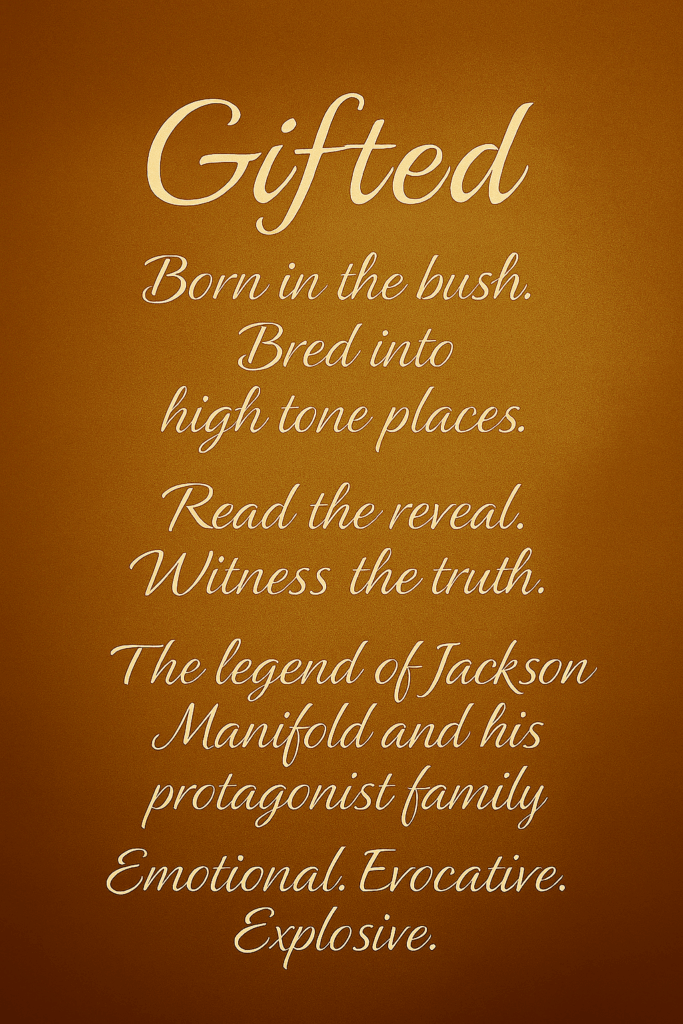
I've dedicated this book to the “grinders.” Though gifted in every sport he tried, Jackson Manifold surrounded himself with doers. People who didn't quit. Because only with them in his team could he succeed.
And that's where I'll leave it. I hope you enjoy Gifted 1. I will catch up with you again when I release Gifted 2, hopefully around Christmas time. In the meantime, if you fill out the registration form, I will send you occasional updates with news about the Legend, Jackson Manifold, and his gifted family. And Gifted 2-featuring Australia's “Songbird of Soul,” BiBi Manifold.
Oh- I've got one son and three daughters, a daughter-in-law, two sons-in-law, and seven grandchildren. Each and every one of them is a blessing.
The Mind Behind the Words
The Creative Intent
Gifted is a sweeping, evocative tale that journeys across the vast landscapes of Australia and the world, drawing readers into a narrative that is as powerful as it is deeply human. At its heart, it is a story of betrayal—and a story of recovery.
This journey confronts the seductive allure of wealth and beauty, the intoxicating influence of the cosmetic industry and social media, and the quiet devastation of addiction. It celebrates music, resilience, and the often overlooked but profound significance of belonging—especially for those most vulnerable.
Told with an authentic Australian voice and grounded in universal themes, Gifted uncovers the hidden truths beneath society’s glossy surface, challenging readers to reflect on their own values in a rapidly changing world.
The Inspiration
While the events in this novel are fictional and dramatized, Jack’s story resonates with the author’s own life experiences.
He too, as a young adult, was shaped by the rugged culture of hill‑country farming—a place where resilience and determination were not just values, but the very air farm‑hands breathed. Lessons were taught the hard way—by being thrown in the deep‑end. Isolation was normal. These lessons and lifestyle removed complacency from the equation and carried him from the bush to the boardroom.
Later, as a director of a Sports Management Agency, he worked closely with elite athletes. Their commitment to winning was relentless. But no one wins forever. It was in their losing streaks that he saw something deeper: vulnerability. Some bounced back. Others didn’t. That’s where the real story lived. Not just the fall—but the rising.
And behind those public struggles were the private ones—the wives, the children, the families whose own lives often unravelled in the shadows. Their stories needed telling, too.
Now, at a later stage in life, the author returns to storytelling with fresh eyes and a deeper well of empathy. He believes tales of redemption, betrayal, family, friendship, and the indomitable human spirit will always matter.
Genre & Themes
The main character, Jackson Barton Manifold, is a humble man. But his legend precedes him. He is a national icon—not just for his victories, but for his public heartbreaks. Alongside his five gifted children, including his 28‑year‑old son with Down syndrome, his story becomes a family saga of epic proportions.
Firmly rooted in the Literary Family Drama genre—yet laced with suspense and thriller elements.
Formats Available: Paperback · Hardcover · eBook · Audible
